In the previous article, we examined the domestic batch rail: a freight-train architecture designed to move massive volumes of money by trading speed for computational efficiency. Batch rails rely on deferred settlement, fixed-width file parsing, and overnight bulk updates to avoid database lock contention.
But the foundational constraint of the batch era was never business logic; it was I/O and compute.
As core banking ledgers transitioned from monolithic mainframes to horizontally sharded, in-memory architectures, the industry reached an inflection point. If the ledger can process a debit in milliseconds, why defer settlement for days?
Real-time payment rails (like FedNow, RTP, and Faster Payments) represent a fundamentally different processing architecture from batch systems. They are not simply “faster batch files.”
Instead, they are continuous, message-driven networks where payment validation, fraud evaluation, account posting, clearing, and settlement coordination occur within a tightly constrained real-time workflow.
The systems achieve rapid settlement finality through acknowledgements, strong processing guarantees, liquidity management, and reconciliation rather than through a single global atomic transaction.
1. The Participants
Unlike the batch rail’s hub-and-spoke model with deferred settlement, real-time payment rails operate as a synchronous, message-switching network. The participants are fewer, but their roles are more demanding due to the requirement for sub-second finality.
| Participant | Role | Real-Time Constraint |
|---|---|---|
| Originator | The person or business initiating the payment (e.g., a consumer or a business). | Must generate a strictly idempotent payment message with a unique End-to-End ID. |
| Originating Bank | The financial institution holding the Originator’s account. | Must validate available funds, apply risk controls, record the debit according to its ledger model, and submit the payment message to the switch within the scheme’s timing requirements. |
| Real-Time Switch | The central or distributed network operator (e.g., FedNow, The Clearing House for RTP). | Must route messages, validate transaction identifiers, enforce idempotency, and coordinate processing within the scheme’s real-time service-level requirements ( around under 500ms). |
| Receiving Bank | The financial institution holding the Recipient’s account. | Must validate the incoming payment message, apply risk controls, post the credit according to its ledger model, and return an acceptance or rejection response. |
| Central Bank | The ultimate settlement authority (e.g., Federal Reserve, ECB). | Must process settlement according to the scheme’s settlement model, such as direct reserve account adjustments or settlement through a designated settlement account. |
| Recipient | The person or business receiving the payment. | Receives immediate, irrevocable funds. |
| Fraud Engine | The system evaluating the risk of each transaction. | Must complete fraud evaluation within the overall real-time payment SLA, often requiring millisecond-to-low-hundreds-of-milliseconds decisioning. |
How They Interact
- Originator sends a payment instruction to their Originating Bank (e.g., via a mobile app or API).
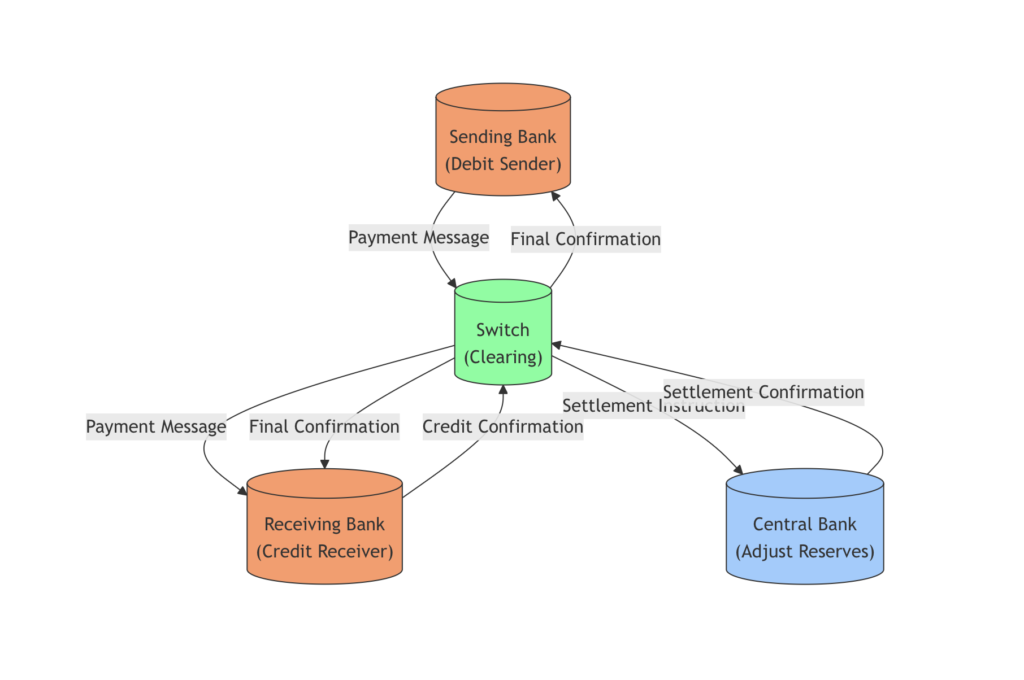
- Originating Bank validates the request, records the outgoing payment according to its ledger model, and forwards the payment message to the Real-Time Switch.
- Real-Time Switch checks for idempotency, routes the message to the Receiving Bank, and ensures the transaction is not a duplicate.
- Receiving Bank validates the incoming payment, posts the credit according to its ledger model, and returns an acceptance or rejection response through the switch.
- Central Bank (or a designated settlement agent) adjusts the reserve accounts of the Originating and Receiving Banks in real time.
- Fraud Engine (co-located with the switch or bank) evaluates the transaction in-process to meet the sub-500ms SLA.
Key Difference from Batch:
In batch rails, the Clearinghouse Operator and Central Bank work asynchronously, netting transactions over hours or days.
In real-time rails, the switch and settlement mechanism operate within a tightly coordinated real-time workflow, allowing transactions to achieve rapid finality once scheme-defined processing conditions are satisfied.
2. The Paradigm Shift: Settlement
On a batch rail, clearing and settlement are asynchronous events that happen hours or days after the payment instruction is sent.
The payment message and settlement process are coordinated as a real-time workflow, producing rapid finality once the required participants confirm successful processing. Unlike batch systems, there is no long clearing window, but the underlying systems remain distributed and rely on messaging guarantees, acknowledgements, and reconciliation rather than a single atomic database commit.
When a real-time payment is executed, the Switch coordinates message exchange between participating institutions and the settlement mechanism. The exact sequencing depends on the payment scheme, but the objective is to complete clearing and settlement within the same real-time transaction lifecycle.
The sending bank records the debit, the receiving bank records the credit, and the settlement mechanism updates the corresponding interbank positions according to the payment scheme’s settlement model.
There is no multi-day clearing window or overnight settlement delay. Internally, however, payment systems still maintain transaction states such as received, validated, accepted, rejected, settled, and reconciled.
Successful transactions achieve rapid finality, typically within seconds, once the payment scheme’s acceptance and settlement conditions are satisfied. The Switch coordinates status exchange and ensures participants have a consistent transaction outcome through scheme-level guarantees and reconciliation.
This requirement forces a departure from traditional card networks.
In card networks, authorization typically creates an approval decision or hold, while clearing and settlement occur later through separate processes. Real-time payment systems differ by combining payment initiation, clearing, and settlement within a much shorter operational window.
Real-time payment schemes are designed for immediate authorization and settlement rather than the authorization-hold model common in card networks. However, participating institutions may still apply internal controls, risk checks, or exception workflows before completing the transaction.
3. The Engineering Constraints of Immediate Finality
Building a system that coordinates thousands of transactions per second (TPS) across independent financial institutions introduces distributed systems challenges that batch systems largely avoided.
3.1. The Locking Bottleneck
Naively implementing real-time settlement using row-level locking (for example, SELECT ... FOR UPDATE) quickly becomes a scalability bottleneck as contention increases. Banks do run Oracle, PostgreSQL, SQL Server, and DB2 successfully, but the challenge lies in contention and latency, not the inherent inability of relational databases.
To achieve sub-second finality, modern payment platforms may use techniques such as partitioning, event-driven architectures, in-memory processing, or actor-style concurrency models to reduce contention.
However, many large banks continue to operate high-volume payment workloads on traditional relational databases and mainframe systems with extensive optimization.
Some modern payment platforms partition account ownership and serialize updates through mechanisms such as actors, partitioned services, or event-driven architectures. These approaches reduce contention by controlling concurrent access to account state while maintaining durable audit trails.
3.2. Idempotency at the Edge
In a batch file, if a row fails, the whole file rejects, and the originator resubmits. In a real-time API, network partitions and TCP timeouts are inevitable. If a sender’s application times out waiting for a response after 2 seconds, it will retry the API call.
Because the funds were already irrevocably transferred on the first attempt, a naive retry will double-debit the sender and double-credit the receiver.
Real-time rails solve this by enforcing strict, network-level idempotency. Every request requires an End-to-End ID (a UUID). The Switch maintains durable idempotency records using transaction identifiers and optimized lookup mechanisms.
In-memory caches or probabilistic structures such as Bloom filters may be used as performance optimizations, but they cannot be the sole source of truth because false positives and data loss risks are unacceptable in financial transactions.
If a duplicate arrives, the Switch returns the previously recorded transaction outcome without repeating the financial side effect.
Exactly-Once Effects in Distributed Systems
Distributed systems cannot guarantee exactly-once delivery over unreliable networks. Real-time payment systems instead combine at-least-once delivery with idempotent processing to achieve exactly-once effects. This pattern is a defining principle in payment infrastructure:
- At-least-once delivery ensures the message is processed, even if it means retries.
- Idempotent processing ensures that retries do not cause duplicate side effects (e.g., double-debiting an account).
- Reconciliation (covered later) acts as a final safety net to detect and correct any inconsistencies.
This approach allows real-time rails to maintain consistency and reliability despite the inherent unpredictability of distributed networks.
4. The Fraud Challenge: Decisioning at the Speed of Light
The biggest casualty of the batch era was the “float.” A three-day delay gave fraud engines days to run batch analytics, aggregate signals, and reverse fraudulent transactions before settlement occurred.
Real-time rails compress the fraud decision window from hours or days in traditional batch environments to milliseconds or seconds, depending on the payment scheme and risk controls. By the time the real-time switch routes the message to the receiving bank, the decision to accept or reject must already be made.
4.1. The Feature Retrieval Problem
The larger challenge in real-time fraud detection is often feature retrieval rather than model execution. To make an accurate fraud decision in under 500ms, the system must:
- Assemble a comprehensive feature set in tens of milliseconds, including:
- Device fingerprints (e.g., IP address, device ID, geolocation).
- Account behavior (e.g., transaction history, velocity checks, typical payment patterns).
- Historical signals (e.g., past fraud incidents, chargeback history).
- Contextual data (e.g., time of day, merchant category, payment amount).
- Co-locate feature stores with the payment switch to minimize latency. Distributed caches (e.g., Redis) or in-memory databases are commonly used to store and retrieve these features quickly.
4.2. In-Process Machine Learning
Fraud scoring in a real-time rail must be optimized for low latency. This may involve in-process inference, co-located services, cached features, or other architectures designed to minimize decision time. This requires:
- Compiled ML models (e.g., ONNX Runtime, PMML) that can run directly on the CPU thread processing the transaction.
- Pre-loaded models in memory to eliminate the overhead of loading models for each transaction.
- Optimized inference engines that can execute complex models (e.g., gradient-boosted trees, neural networks) in under 50ms.
4.3. Rule-Based vs. ML-Based Fraud Detection
While machine learning models provide adaptive and sophisticated fraud detection, rule-based systems still play a critical role in real-time rails:
- Rule-based checks (e.g., velocity limits, blacklists, geolocation mismatches) are executed first because they are fast and deterministic.
- ML-based models are then applied to transactions that pass the rule-based checks, providing a second layer of defense against more subtle fraud patterns.
4.4. The Trade-Off: False Positives vs. False Negatives
Real-time fraud systems must balance false positives (legitimate transactions flagged as fraud) and false negatives(fraudulent transactions allowed through):
- False positives lead to customer friction (e.g., declined transactions, manual reviews).
- False negatives lead to financial losses (e.g., chargebacks, fraudulent payouts).
The threshold for flagging transactions as fraudulent is carefully tuned to minimize both types of errors, often using adaptive thresholds that adjust based on real-time fraud rates.
4.5. Real-Time Fraud Workflow
Here’s how fraud detection typically works in a real-time payment rail:
- Feature Retrieval: The system gathers all relevant features (device, account, historical, contextual) in under 50ms.
- Rule-Based Checks: The transaction is evaluated against a set of predefined rules (e.g., “Block if the transaction amount exceeds $10,000”).
- ML-Based Scoring: If the transaction passes the rule-based checks, it is scored using an ML model (e.g., “Fraud probability: 0.85”).
- Decision: Based on the rule-based results and ML score, the system either:
- Approves the transaction (if the fraud risk is low).
- Rejects the transaction (if the fraud risk is high).
- Flags for Review (if the fraud risk is uncertain, triggering manual or automated further investigation).
- Feedback Loop: The outcome of the transaction (e.g., confirmed fraud, false positive) is fed back into the system to improve future fraud detection.
Design Takeaway:
Fraud detection in real-time rails is a multi-layered, in-process operation that combines rule-based checks, ML models, and real-time feature retrieval. The key challenge is assembling the necessary features quickly and executing the models efficiently within the strict latency constraints.
5. The Protocol Shift: From Fixed-Width to ISO 20022
Traditional ACH batch processing commonly uses fixed-width file formats such as NACHA records. These formats were designed for efficient bulk processing and predictable parsing rather than rich, real-time messaging.
Most major modern instant payment schemes, including FedNow, RTP, and SEPA Instant, use ISO 20022 as their messaging foundation, a standard that defines a business model and message definitions.
Most regulated payment schemes currently define ISO 20022 messages using XML-based schemas, while API-based implementations may expose JSON representations or translate between formats internally.
The engineering shift is significant: ISO 20022 messages can be significantly larger and more complex than legacy fixed-width formats, especially when carrying rich remittance and party information.
Real-time gateways cannot afford to parse these using DOM parsers, which load the entire XML tree into JVM heap memory, causing GC spikes. High-throughput switches use streaming parsers (like StAX or Jackson streaming APIs) to extract only the critical routing and financial elements (Amount, Account, Idempotency Key) and discard the rest, minimizing heap allocation.
Furthermore, ISO 20022 carries rich remittance data because modern payment systems increasingly support corporate payments, reconciliation, and automated financial workflows. It complements existing wire and payment networks rather than simply replacing them.
6. The Global Architectures
While the engineering principles are universal, the topology of real-time networks varies by region:
| Region | System | Architecture | Settlement Mechanism | Message Format |
|---|---|---|---|---|
| United States | FedNow | Central Hub | Payment messages are processed through the network while settlement occurs through the scheme’s designated Federal Reserve settlement mechanism. | ISO 20022 (XML) |
| United States | RTP | Central Hub | Payment messages are processed through the network while settlement occurs through the scheme’s designated Federal Reserve settlement mechanism. | ISO 20022 (XML) |
| Europe | SEPA Instant | Distributed Mesh | TIPS (ECB) | ISO 20022 |
6.1. Central Hub (US – FedNow / RTP)
The US operates on a hub-and-spoke model. All banks connect to a central, highly redundant switch operated by the Fed (for FedNow) or The Clearing House (for RTP). The central hub handles routing, enforces idempotency, and facilitates immediate settlement.
- For FedNow, settlement occurs directly via adjustments to the banks’ master accounts at the Federal Reserve.
- For RTP, settlement is processed through The Clearing House’s joint account at the Federal Reserve, rather than direct adjustments to each bank’s reserve balances.
6.2. Distributed Mesh (Europe – SEPA Instant)
SEPA Instant operates through an interconnected ecosystem of banks, clearing mechanisms, and settlement infrastructures. Banks may connect through different clearing providers, while settlement can be supported through infrastructures such as TARGET Instant Payment Settlement (TIPS). Unlike the US model, Europe has multiple interconnected providers rather than a single dominant instant payment switch.
7. High Availability: The Rail Cannot Stop
Real-time payment systems care about availability almost as much as latency. Downtime is not an option when money must move 24/7. Achieving this requires a distributed systems approach:
- Active-Active Deployment: Multiple instances of the payment switch run simultaneously across data centers or regions, sharing the load and providing redundancy.
- Replication strategies balance consistency, availability, and latency requirements. Some systems use synchronous replication, while others rely on quorum-based or asynchronous approaches depending on the component and failure model.
- Consensus and Quorum: Systems use consensus protocols (e.g., Raft, Paxos) to agree on the state of transactions across nodes, ensuring that a majority (quorum) of nodes must confirm a transaction before it is finalized.
- Split-Brain Avoidance: Mechanisms are in place to prevent split-brain scenarios, where nodes become partitioned and begin processing transactions independently, leading to inconsistencies.
- Regional Failover: If a primary data center fails, traffic is automatically rerouted to a secondary region with minimal disruption.
- Recovery Objectives: Real-time systems aim for RPO (Recovery Point Objective) ≈ 0 (no data loss) and RTO (Recovery Time Objective) in seconds, ensuring that the system can recover almost instantaneously from failures.
Design Takeaway:
High availability is not just about redundancy; it’s about synchronous coordination, consensus, and failover mechanisms that ensure the rail never stops.
8. Liquidity: The Operational Backbone
Batch systems rely on netting to minimize the movement of funds between banks. Real-time rails, however, require liquidity throughout the day.
- Prefunding Settlement Accounts: Banks must prefund their settlement accounts to ensure they have sufficient balances to cover outgoing payments in real time.
- Intraday Liquidity Monitoring: Banks continuously monitor their liquidity positions to avoid shortages that could disrupt settlement.
- Liquidity Recycling: Funds received from incoming payments are immediately recycled to cover outgoing payments, ensuring efficient use of available liquidity.
Why It Matters:
Without sufficient liquidity, real-time settlement cannot function. Banks must actively manage their intraday liquidityto support the immediate, irrevocable nature of real-time payments.
9. The Architecture Revealed
Real-time payment rails are not merely an evolution of batch systems; they represent a fundamentally different processing architecture.
They reduce reliance on deferred processing windows by moving validation, settlement coordination, and reconciliation closer to the transaction event.
In return, they force the adoption of:
- Strictly idempotent APIs
- Low-latency state management and optimized ledger architectures
- Streaming XML parsers
- Co-located machine learning inferencing
The money moves as fast as information because modern payment networks have optimized every stage of the transaction lifecycle: messaging, risk evaluation, liquidity management, ledger posting, settlement, and reconciliation.
10. System Design Lessons from Real-Time Rails
Real-time payment systems like FedNow, RTP, and SEPA Instant are a masterclass in low-latency, high-availability distributed systems. Here are key takeaways for software architects and engineers:
10.1. Immediate Finality: The Consistency Requirement
Real-time rails treat every payment as a tightly coordinated transaction workflow requiring deterministic processing, idempotency, durable audit trails, and rapid confirmation. This requires:
- In-memory ledger updates to avoid database locks.
- Idempotency keys to prevent duplicate processing.
- Append-only event logs for auditability and recovery.
Design Takeaway:
If your system requires immediate finality, design every operation to be deterministic, idempotent, auditable, and resilient to retries. Use appropriate state-management patterns, durable transaction records, and asynchronous processing where possible to achieve predictable latency without sacrificing correctness.
10.2. Message as Settlement: The Protocol Inversion
In batch systems, the message is an instruction; In real-time systems, payment processing and settlement coordination occur within a tightly coupled workflow, but the underlying institutions still operate independent ledgers connected through messaging and settlement mechanisms. This inversion requires:
- Rich, standardized messaging (ISO 20022) to carry all necessary data.
- Streaming parsers to handle large, nested messages efficiently.
- Optimized formats to minimize overhead.
Design Takeaway:
Adopt protocols that are both expressive and efficient. Use streaming parsers for large messages and optimized formats for high-throughput systems.
10.3. Fraud at the Speed of Light
Real-time rails demand sub-500ms fraud detection. This requires:
- In-process ML inferencing to avoid network latency.
- Co-located feature stores for fast access to historical data.
- Compiled models (ONNX, PMML) for CPU-bound execution.
Design Takeaway:
For low-latency systems, co-locate compute and data. Use compiled models and in-memory stores to meet strict SLAs.
10.4. Idempotency as a First-Class Concern
In real-time systems, retries are inevitable. Without idempotency, retries can lead to duplicate processing and financial discrepancies.
Design Takeaway:
- Use unique IDs for every request.
- Maintain durable idempotency records, optionally accelerated by in-memory caches, to detect duplicate requests.
- Return cached responses for duplicate requests to avoid ledger updates.
10.5. Sharding and Actor Models: Avoiding the Locking Nightmare
Traditional database designs based on heavy row locking can struggle with the latency and concurrency requirements of real-time rails. The challenge is not the database technology itself, but contention, transaction coordination, and predictable low-latency performance at scale. Instead, use:
- Sharding to distribute load across partitions.
- Actor models to serialize updates to a single account.
- Append-only logs to record all changes asynchronously.
Design Takeaway:
Avoid uncontrolled locking contention. Depending on workload characteristics, systems may use partitioning, serialization models, event sourcing, optimized relational designs, or actor-style concurrency.
10.6. The Cost of Real-Time: Complexity vs. Speed
Real-time rails offer instant settlement, but at the cost of increased complexity. Batch systems are simpler, cheaper, and more forgiving of failures. Real-time systems require:
- Highly available infrastructure to avoid downtime.
- Strict SLAs for every component in the pipeline.
- Advanced monitoring to detect and resolve issues in real time.
Design Takeaway:
Real-time systems are not always the best choice. Evaluate the trade-offs between speed, cost, and complexity for your use case.
11. Reconciliation in Real-Time: The Invisible Safety Net
Even in real-time systems, reconciliation is not optional. While batch rails reconcile overnight, real-time rails require continuous, automated reconciliation to ensure accuracy, prevent fraud, and maintain trust. Without it, the system would be vulnerable to discrepancies, duplicate transactions, and financial losses.
Reconciliation in real-time systems must ensure consistency across three independent sources of truth:
- Payment Switch (the message and its routing)
- Bank Ledger (the account balances)
- Settlement Ledger (the reserve account adjustments)
These three must converge to ensure the system remains accurate and reliable.
11.1. The Role of Reconciliation in Real-Time Rails
Reconciliation in real-time systems ensures that:
- The payment message matches the ledger update in both the originating and receiving banks.
- The settlement instruction sent to the central bank aligns with the net adjustments in reserve accounts.
- The Switch verifies that required confirmations and settlement states align. Exceptions are handled through defined recovery, repair, and reconciliation processes rather than distributed rollback.
- Idempotency is enforced at every step to prevent duplicate processing.
- Fraud checks are validated against the final transaction state.
Why It Matters:
- Prevents Financial Loss: A single duplicate or misrouted transaction can result in significant discrepancies.
- Ensures Compliance: Regulatory bodies require meticulous records of all transactions, even in real-time systems.
- Builds Trust: Customers and businesses expect immediate and accurate settlements.
11.2. Where Reconciliation Fits in the Real-Time Lifecycle
Reconciliation is not a single step—it’s a continuous process embedded in every phase of the real-time transaction lifecycle.
| Phase | Reconciliation Point | Key Validation |
|---|---|---|
| Initiation | Originating Bank validates the payment request. | Message format adheres to ISO 20022. Idempotency key is unique. |
| Routing | Real-Time Switch validates the message. | No duplicate End-to-End IDs. Message is correctly routed to the Receiving Bank. |
| Settlement | Central Bank adjusts reserve accounts. | Net debit/credit totals match the settlement instructions. |
| Posting | Receiving Bank updates the ledger. | Ledger update matches the cleared transaction. No duplicate credits. |
| Customer-Level | Recipient verifies the deposit. | Actual deposit amount matches the expected amount. |
11.3. Architecting Reconciliation for Real-Time Systems
Reconciliation in real-time systems must be automated, scalable, and foolproof. Here’s how to design it:
11.3.1. Layers of Reconciliation
Reconciliation operates at multiple layers, each with its own validation logic:
| Layer | Validation | Tooling |
|---|---|---|
| Message-Level | Validate ISO 20022 message format and idempotency key. | Streaming parsers (StAX, Jackson), schema validation, and durable transaction identifiers. |
| Switch-Level | Ensure no duplicate messages are processed. | Durable idempotency stores, distributed caches, and transaction state tracking. |
| Settlement-Level | Confirm reserve account adjustments match net settlement instructions. | Double-entry accounting, real-time ledger updates. |
| Posting-Level | Match cleared transactions to ledger updates. | Idempotent transaction IDs, append-only event logs. |
| Customer-Level | Customers verify deposits in real time. | Mobile app notifications, API endpoints for balance checks. |
11.3.2. Automation: The Key to Scalability
Reconciliation must be fully automated to handle the scale of real-time rails. Manual reconciliation is unsustainable for systems processing thousands of TPS.
- Real-Time Validation:
- Validate message formats and idempotency keys as the transaction flows through the system.
- Use streaming parsers to extract and validate critical fields without loading entire messages into memory.
- In-Memory Tallies:
- Maintain running totals of debits and credits in memory to detect discrepancies in real time.
- Use distributed caches (e.g., Redis) to track idempotency keys and prevent duplicates.
- Double-Entry Accounting:
- Ensure that financial movements remain balanced across accounting domains.
- Use append-only event logs to record all transactions for auditability.
- Cryptographic Hashes:
- Use SHA-256 or similar hashes to validate message integrity and prevent tampering.
11.3.3. Error Handling and Alerts
Even with automation, discrepancies will occur. Here’s how to handle them:
- Alerts:
- Notify engineers or operations teams of mismatches via Slack, PagerDuty, or email.
- Example: If a duplicate transaction is detected, trigger an alert and reject the duplicate.
- Retries:
- Implement exponential backoff for failed reconciliations (e.g., retry in the next millisecond or batch window).
- Example: If a ledger update fails, retry the update with the same idempotency key.
- Manual Overrides:
- Provide a workflow for human intervention when automation fails.
- Example: Allow a compliance officer to manually reverse a fraudulent transaction.
11.4. Engineering Reconciliation: Code and Patterns
Reconciliation in real-time systems requires practical implementation. Below are patterns to integrate reconciliation into your system:
11.4.1. Idempotency
- Use unique transaction IDs (UUIDs) to ensure operations can be safely retried without side effects.
- Example: If a payment message with the same End-to-End ID is received twice, return the cached response without processing it again.
11.4.2. Audit Logs
- Log every reconciliation step for traceability.
- Include timestamps, transaction IDs, and validation results in the logs.
- Example: Log the result of every idempotency check, settlement adjustment, and ledger update.
11.4.3. Real-Time Alerts
- Integrate with monitoring tools (e.g., Prometheus, Datadog) to trigger alerts for reconciliation failures.
- Example: If a ledger update fails to match the cleared transaction, trigger an alert and pause further processing.
11.4.4. Automated Retries
- For failed reconciliations, implement exponential backoff to avoid overwhelming the system.
- Example: If a settlement instruction fails, retry it after 100ms, 200ms, 400ms, etc.
11.4.5. Data Integrity
- Use cryptographic hashes to validate message contents and prevent tampering.
- Example: Compute a SHA-256 hash of the ISO 20022 message and compare it with the expected hash.
11.5. Final Thoughts: Reconciliation as a First-Class Citizen
Reconciliation is the safety net of real-time payment systems. It ensures that the vast, invisible infrastructure moving trillions of dollars daily remains accurate, reliable, and trustworthy.
For software architects and engineers, this means:
- Design reconciliation into every phase of the real-time lifecycle.
- Automate everything to handle scale and reduce human error.
- Monitor and alert to catch discrepancies early.
- Treat reconciliation as a feature, not an afterthought.
By doing so, you’ll build systems that are not just fast—but correct.
12. Final Thought: The Future of Money Movement
Batch rails were a testament to the power of deliberate trade-offs—sacrificing speed for cost and scalability. Real-time rails, on the other hand, prioritize immediacy and availability, even at the cost of greater complexity.
As a software architect, the choice between batch and real-time depends on your use case:
- Batch rails excel in high-volume, low-margin operations where speed is secondary (e.g., payroll, B2B invoices).
- Real-time rails are essential for urgent, high-value transactions where immediacy is critical (e.g., P2P transfers, B2B settlements).
The future of financial infrastructure likely lies in hybrid systems that combine the cost-efficiency of batch with the speed and reliability of real-time. By understanding the architectural principles behind both models, you can design systems that are efficient, resilient, and scalable—whether money moves at the speed of a freight train or a bullet train.